The Linen Dress: Your Most Versatile Piece

A well-chosen linen dress might be the single most powerful item in a travel suitcase. The key is choosing a silhouette that doesn't belong definitively to any one time of day. Avoid overly structured shapes — instead, reach for relaxed cuts that move naturally, with enough ease to feel comfortable in heat but enough form to feel intentional at dinner.

Midi lengths are especially useful: long enough to feel appropriate in more conservative destinations, short enough to feel light and easy in coastal or resort settings. A neutral palette — sand, ecru, sage, or terracotta — ensures your linen dress pairs effortlessly with the accessories you'll discover along the way.

The Linen Bandeau: Underestimated Power Piece

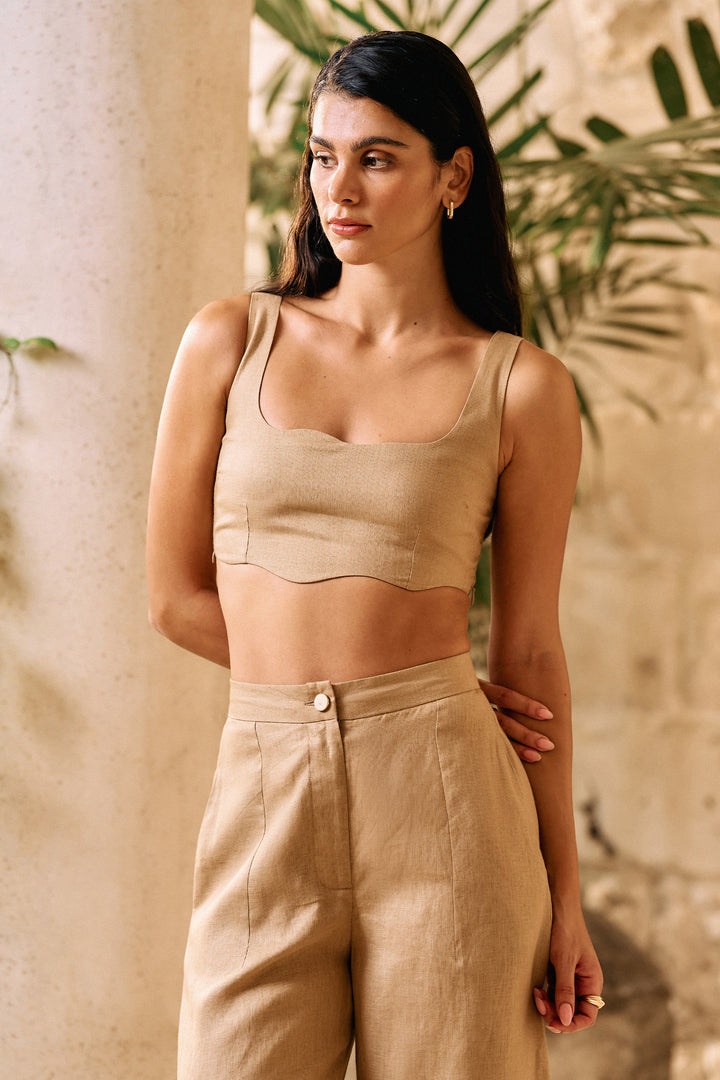
The linen bandeau is a study in versatility. It works as a standalone top paired with linen bottoms for beach days, functions as a layering piece under a sheer blouse, and tucks neatly into a bag when you want to transition into something else. In linen, it also breathes far better than its stretch-fabric equivalents, meaning you'll reach for it every single day.

Choose a bandeau with a slight structure rather than a fully boned or padded alternative — the natural drape of linen reads better when the piece has some ease to it. Matching your bandeau to your linen co-ord or pairing it with contrasting linen bottoms are both excellent approaches.

The Linen Shirt: The Great Layerer

If linen has a hero garment for travel, it is the linen shirt. Worn fully buttoned with the collar open and sleeves rolled, it is effortlessly polished. Layered over a bandeau and linen trousers, it becomes a cover-up, a layer, a statement. Tied at the waist over a dress, it transforms the silhouette entirely.

Pack one oversized linen shirt, and you have, in effect, packed four different outfits. Look for quality — the weave should feel substantial but not heavy, and the colour should have some depth (undyed or garment-dyed pieces tend to have the most character).

Linen Bottoms: The Foundation

Whether you prefer wide-leg linen bottoms in a tailored cut or a more relaxed, pull-on pant, this piece is the anchor of your entire travel wardrobe. A single pair of well-chosen linen trousers can pair with every other linen piece you've packed, and with most non-linen tops too.

Consider investing in a slightly more considered cut — a subtle flare, a paper-bag waist, or a wide palazzo leg — rather than a strictly straight silhouette. These details catch the air and move beautifully as you walk, which is both practical (airflow) and aesthetic (the whole point).

The Case for a Linen Co-Ord Set

Of all the linen combinations you might pack, the linen co-ord set makes the strongest argument for effortless travel dressing. A matching top-and-bottom set in the same fabric and wash removes all decision-making — you simply put it on, and you are dressed.

But the co-ord set is more than a lazy choice. Worn together, the matching pieces create a coherent, intentional look that reads almost as a dress but with the flexibility of separates. Worn apart, each piece extends your wardrobe's range considerably.

Completing the Look: Accessories & Footwear

The right accessories transform a linen wardrobe from thoughtful to extraordinary. This is where the cumulative care you've put into your packing pays off — linen is a fabric that asks for accessories with soul.

Sandals: The Other Essential

Linen clothes ask for footwear that shares their easy confidence. Sandals are the natural partner — flat or low-heeled, leather or woven, strappy or simple. The key is choosing footwear that is genuinely comfortable for walking (because you will be walking) while looking intentional enough to carry the aesthetic from daytime to evening.

Look for sandals with real construction — quality straps, durable soles, and a last that won't blister after the first day. Artisan-made sandals in natural leather or raffia are the ideal companions to a linen wardrobe; they share the same respect for material and making that defines this whole approach to getting dressed.

Jewellery: The Finishing Touch

Linen calls for jewellery that feels equally natural — pieces with texture, warmth, and some element of craft. Shell necklaces, freshwater pearl drops, beaten gold cuffs, and mixed-metal earrings all work beautifully against the texture of linen. The goal is layering pieces that have some presence without competing with the relaxed ease of the fabric.

For travel, prioritise jewellery that is lightweight and can be layered to create different effects with the same few pieces. A postcard-inspired or artisan-made collection — pieces that carry the spirit of the places you visit — is particularly rewarding to build over time.

How to Pack Linen Without the Wrinkle Regret

The most common hesitation about building a travel wardrobe around linen is the wrinkling question. Here's the practical reality: with the right packing approach, linen wrinkles are entirely manageable. And for many pieces, they're barely noticeable.

The Linen Packing Method

  • Roll, don't fold. Rolling linen garments rather than folding them dramatically reduces the number of hard crease lines. Fold-creases press into the fabric for hours; roll-curves fall out quickly.
  • Pack linen in the middle layer. Surrounded by softer items (underwear, swimwear, knitwear), linen pieces are cushioned from hard folds.
  • Travel with a small spray bottle. A light misting of water on a linen garment, followed by a gentle tug and hang, removes most travel creases within 20–30 minutes.
  • Embrace the texture. A linen dress that has been worn and lived in looks better than a stiffly ironed one. The natural texture of linen is part of the aesthetic — lean into it.
  • Heavier-weight linens crease less. If crease-resistance matters to you, choose mid-to-heavyweight linen over the lightest sheers.

Conclusion

Travel wear built around linen is, at its core, a philosophy as much as a wardrobe strategy. It says: I am here to experience things, and what I'm wearing reflects that. The clothes move with me. The bag I carry was made by someone's hands. The sandals I've broken in will outlast this trip. Everything I've brought with me is here on purpose.

Build your linen wardrobe slowly, choose genuinely well-made pieces, and invest in the accessories — the bag, the jewellery, the sandals — that carry the same level of care. You will find that fewer, better pieces create more outfits, more memories, and a deeper relationship with the way you dress when you travel.

That, in the end, is what dressing for the feeling means.

Frequently Asked Questions

Q1. Is linen actually practical as travel wear, or is it just fashionable?

A: Linen is genuinely one of the most practical fabrics for travel, particularly in warm or humid climates. It's naturally breathable (better than cotton in heat), antibacterial (garments stay fresher longer), durable (it strengthens with washing), and lightweight for packing. The wrinkle factor is real but entirely manageable with the right packing approach, and most linen wrinkles fall out naturally with body heat during wear.

Q2. How many linen pieces do I really need for a two-week trip?

A: For most two-week trips, a capsule of five to seven linen pieces is entirely sufficient: one linen dress, one linen co-ord set (which gives you two separates), one linen shirt, one linen bandeau, and one pair of linen trousers. Add a non-linen swim piece and two or three knit or jersey layers for evenings, and you have a complete, highly flexible wardrobe that takes up very little space.

Q3. What's the best way to care for linen while travelling?

A: Most linen garments can be hand-washed in cool water with a gentle detergent and hung to dry — they dry very quickly. In hotel sinks or basins, a quick wash and overnight hang is often all that's needed. Avoid wringing; instead, roll garments in a towel to remove excess water, then hang or lay flat to dry. If a garment has developed deep creases from packing, mist lightly with water and allow to hang — gravity and humidity do most of the work.

April 07, 2026 — Tarun Sagwal