


Sustainable Style, Explained: What Goes Into a Sand by Shirin Co-ord
Ask ten brands what "sustainable" means and you'll get ten different answers, most of them vague. Plenty of "sustainable" co-ord sets promise a lot and explain very little: a green leaf icon, the word "eco" somewhere in the title, not much else.
We'd rather just show the work. SAND stands for "Such A Nice Day" — it's also the earthy colour palette running through nearly everything we make. Here's what actually goes into one of our co-ord sets, fibre to finish. Whether that counts as real sustainable style is up to you.

What does "sustainable" actually mean in a co-ord set
We don't put much stock in a badge or a buzzword. What matters more to us is what the fibre actually is, whether a piece survives years of regular wear and washing, and whether you can style it beyond the one outfit it arrived in.
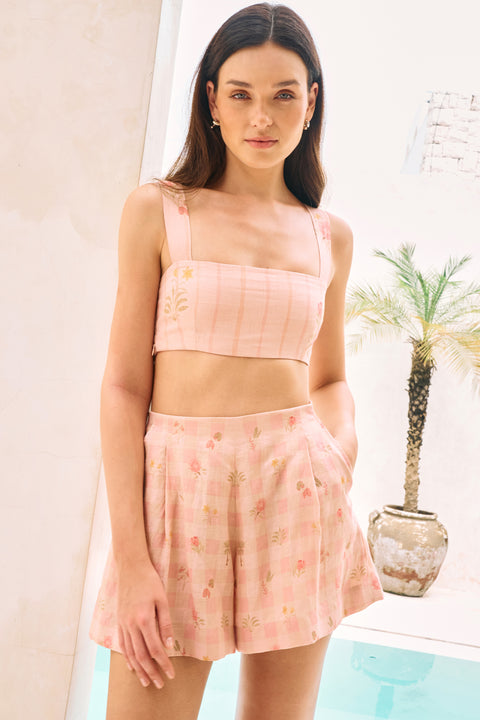
The fabric library behind every co-ord
Every co-ord starts with a fibre choice, and for us that almost always means linen or organic cotton. Both are fair trade certified under the Ecological Plant Fiber Certification, which is our way of putting an actual reference number behind the word "organic" instead of just printing it on a tag.
Linen comes from the flax plant. It breathes, resists holding onto heat, and dries faster than most fabrics you'd find in a summer wardrobe, which is why it's the backbone of pieces like our Osaka set. Linen also has a reputation for being stiff and scratchy, and we spend real processing time softening that hand-feel without losing the fabric's structure or its slightly formal drape. It's also one of the few fabrics that genuinely improves with age, since every wash relaxes it a little more.
Organic cotton does a different job. It's soft from the first wear, forgiving, and suited to pieces you want to feel gentle against the skin. India grows more cotton than any other country in the world, and our mills sit close enough to that supply that we can work directly with the people spinning the yarn.
Beyond these two, our fabric lab experiments with materials most fashion brands don't touch: hand-knotted raffia woven by a cluster of women artisans trained in the craft, cotton spun with soybean protein fibre, and even rose petals turned into thread. Not all of these show up in a co-ord, but they come from the same instinct that shapes our linen and cotton: start with something that grew, not something synthesised.

Design built around how bodies actually change
A co-ord only stays sustainable for as long as you keep wearing it, and fit has more to do with that than most sustainability content admits. Our founder, Shirin Mann, spent close to a year and a half testing drawstring and elastic placements before the current SAND silhouette existed, specifically so a set could sit the same way whether your weight shifts up or down a few kilos across a season.
Shirin's founding belief is that clothing shouldn't judge your body the way it can when it stops fitting. That's a simple idea, but it has a real effect on how long a garment stays in your wardrobe: a co-ord that still fits after your body changes is one you keep, not one you quietly drop into a donation bag. A well-fitted, size-fluid garment probably does more for sustainability than a fabric certificate on its own, because the most sustainable piece of clothing is the one you never have to replace.
Shirin built SAND after founding Needledust, the handcrafted jutti label that launched in 2014, so the thinking behind our fit comes from more than a decade spent working with Indian artisans and craftsmanship, not a single season's trend research.
One set, worn a dozen ways
Buying fewer, better things only works if those things can actually pull double or triple duty — which is why every SAND co-ord splits apart. Wear the top from Osaka or Casablanca over jeans on its own, then put it back with the matching bottoms when you want the full set. The trousers or skirt work the same way, thrown on with some plain shirt already in your closet. One set, three or four outfits.
It holds up across seasons too. Warmer months lean on lightweight linen and organic cotton — the kind of fabric you actually want against your skin when it's hot. Once it cools down, we move into heavier weaves: winter co-ord sets in wool, some in a cashmere-silk-merino blend, same idea as Osaka but for the cold — top and bottom, split-apart, rewearable through the whole season. Buy less, wear it more.
Caring for a co-ord so it actually lasts
Sustainability doesn't end at checkout. How you wash a piece decides how many years you get out of it, and linen and organic cotton both reward a bit of care.
Hand wash linen, or run it on a gentle cold-water cycle. Dry it flat instead of hanging it — hanging stretches the weave out of shape over time. Skip the tumble dryer if you can. Heat is the fastest way to age linen before its time. Linen wrinkles too, and honestly, that's just linen being linen — not something you need to iron into submission. Organic cotton is more forgiving. Cold water, gentle cycle, and keep it out of direct sun while drying, since UV fades natural fibre faster than most people expect.
None of this is complicated, and that's sort of the point. A fabric that needs a dry cleaner and a specialist detergent isn't one most people will actually keep up with, and a co-ord you stop caring for is a co-ord that ends up in landfill years before it should.
Sustainable style by SAND, in practice
Put it all together and sustainable style by SAND isn't one certificate or one clever fabric. It's fair trade certified linen and organic cotton at the core, a fit designed to move with your body instead of against it, pieces built to be worn apart as often as together, and enough care instructions that the set survives past a single season.
If that's the kind of co-ord you're after, our full collection of sustainable co-ord sets is available to browse online, with everything from lightweight summer linen to wool and cashmere-blend winter sets.
FAQs
Q1. What makes Sand by Shirin's co-ord sets sustainable?
A: Three things: the fibre, the fit, and the versatility. Our co-ords are made primarily from linen and organic cotton, both fair trade certified under the Ecological Plant Fiber Certification. The fluid-fit design is built to keep working even as your body changes, and every set is designed to be worn as separates, not only as a matching pair.
Q2. What fabrics are used in a Sand by Shirin co-ord set?
A: Warm-weather co-ords are made mostly from linen and organic cotton, chosen for how they breathe and soften with wear. Winter sets move into heavier fabrics like wool and our cashmere-silk-merino blend. Both our organic linen and organic cotton carry fair trade certification under the Ecological Plant Fiber Certification.
Q3. Can I wear the co-ord top and bottom separately?
A: Yes. Every SAND co-ord is designed so the top and bottom work as standalone pieces, not only as a matched set. Pair the top with jeans you already own, or the trousers or skirt with a plain shirt, and one purchase turns into several outfits.
Q4. Do Sand by Shirin co-ords fit different body types?
A: They're designed to. Our fluid-fit approach uses drawstrings and elastics developed over roughly a year and a half of testing, so a set can sit the same way even as your body shifts size across a season, rather than fitting only one exact measurement.
Q5. How do I wash a linen or organic cotton co-ord?
Hand wash or use a gentle cold-water cycle, and dry the piece flat instead of on a hanger to help it hold its shape. Skip the tumble dryer, and keep organic cotton pieces out of direct sun while drying, since UV fades natural fibre faster than most people expect.
Q6. Are there co-ord sets for both summer and winter?
Yes. Lightweight linen and organic cotton sets are built for warmer months, and wool or cashmere-silk-merino blend co-ords take over for winter, so you can build a co-ord wardrobe that works across the whole year instead of just one season.


